
In short
- Glass fibre doubles or triples the tensile strength and stiffness of a thermoplastic and lifts the heat deflection temperature close to the melting point.
- In return, elongation and notched impact fall, the surface turns matte and shrinkage becomes direction-dependent because fibres align with the flow.
- The difference between GF15 and GF30 is clear in stiffness and small in HDT; the level is chosen by the load and surface expectation of the part.
- Warpage is solved by gate position, mould temperature and, if needed, a low-warp grade with mineral, not by the fibre content.
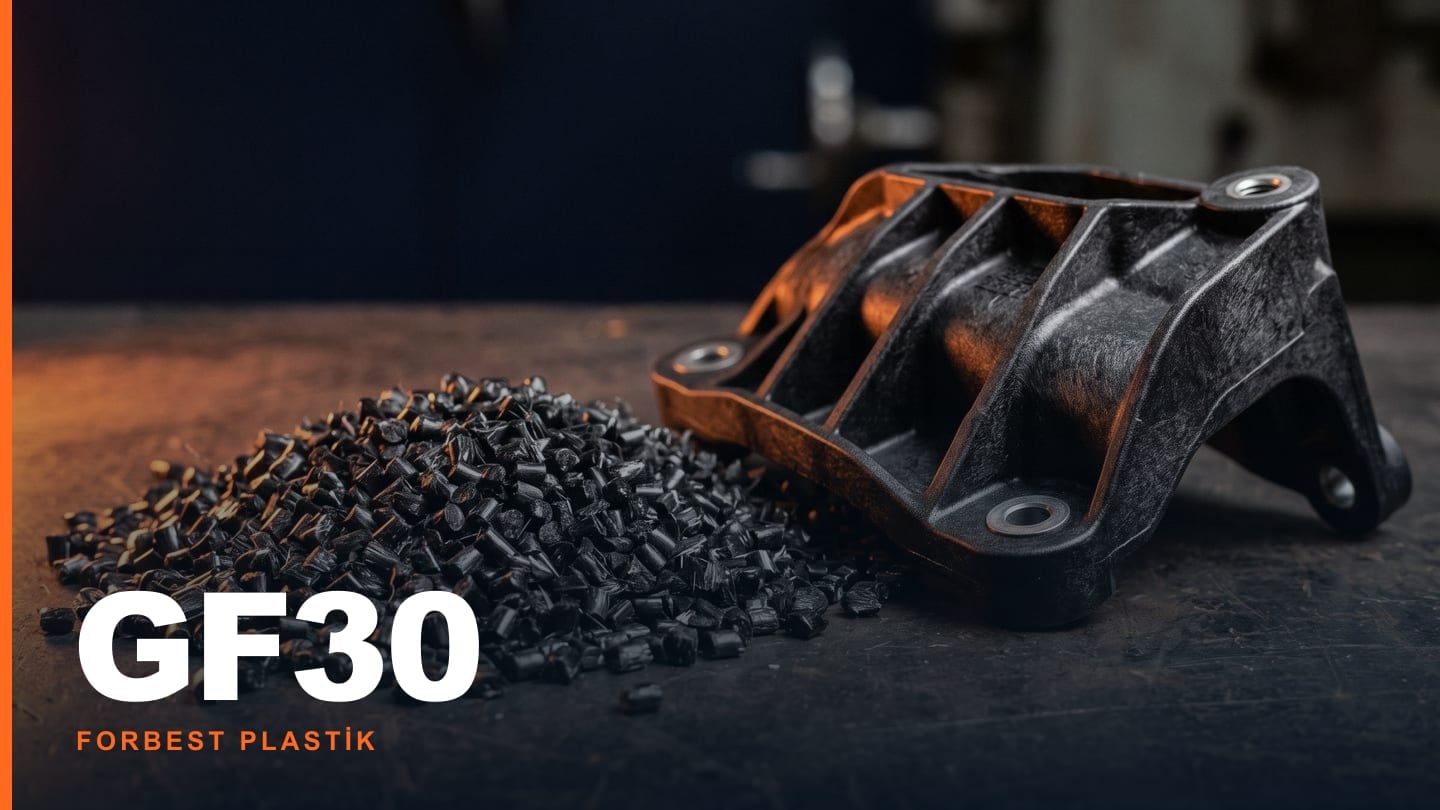
The shortest route to "plastic instead of metal" is glass-fibre reinforcement. Chopped glass fibre is blended into the base polymer in an extruder and fed to injection moulding as pellets; the part comes out of the same mould far stiffer and far more heat resistant. But every gain has a price. This article explains the balance to know when choosing between GF15 and GF30 grades.
What does it add?
Glass fibre builds a load-bearing skeleton inside the polymer. The result shows in three areas:
- Stiffness and strength: Tensile strength and flexural modulus double or triple. Unreinforced PA6 gives 75–85 MPa tensile; PA6 GF30 gives 170–185 MPa.
- Heat resistance: The heat deflection temperature (HDT) moves close to the melting point. PBT's HDT of 55–65 °C rises to 205–215 °C in PBT GF30.
- Creep and dimensional stability: Elongation under load over time drops markedly; screw joints stay tight, covers do not sag.
| Family | Unreinforced tensile | GF30 tensile | Unreinforced HDT | GF30 HDT |
|---|---|---|---|---|
| PA6 | 75–85 MPa | 170–185 MPa | 60–70 °C | 200–210 °C |
| PA66 | 80–90 MPa | 185–195 MPa | 70–80 °C | 240–250 °C |
| PBT | 55–60 MPa | 130–140 MPa | 55–65 °C | 205–215 °C |
| PP | 30–35 MPa | 70–90 MPa | 55–60 °C | 140–155 °C |
Values are typical ranges for the material families; the binding values are in the supplier data sheet.
What does it take away?
As the fibre stiffens, it removes flexibility. Elongation at break drops from hundreds of percent to a few percent; notched impact falls. The surface turns matte and fibre marks can show, which is why low loadings or surface-improved grades are chosen for glossy, visible parts. Density rises: PA6 is 1.13 g/cm³, PA6 GF30 is 1.36 g/cm³, so the same part is about twenty percent heavier. Fibre is abrasive; mould, nozzle and screw life shortens.
Why does warpage happen and how is it solved?
Unreinforced material shrinks similarly in all directions. In glass-filled material the fibres align with the flow; shrinkage drops markedly along the flow and continues across it. On flat, wide parts this difference shows as warpage. The fix is not a different fibre content: gate position, mould temperature and, where needed, a low-warp grade with glass beads or mineral are chosen. That is why we ask for the part geometry in a quote request.
GF15 or GF30?
As the loading rises, stiffness grows almost linearly while HDT saturates early: PA6 GF15 gives 190–200 °C HDT, GF30 200–210 °C. So for heat resistance GF15 is often enough; GF30 is for load-bearing parts exposed to creep. GF15 means a better surface, higher impact and less wear. GF20 and GF25 grades exist as intermediate options; mineral and glass-fibre blends balance surface against stiffness.
Processing notes
Glass-filled material wants a hotter mould; in a cold mould the fibres surface and the part turns matte and rough. In moisture-absorbing families (PA, PBT) drying cannot be skipped; wet material weakens the fibre–polymer bond and the strength loss is permanent. The regrind ratio must stay within the data-sheet limit, because grinding breaks the fibres.
The right loading is set by the load, surface expectation and cost target of the part; our technical team sends two candidate grades for a trial and shares the starting mould temperature in writing.
Frequently asked
What does the 30 in GF30 mean?
30% glass fibre by weight. The volume fraction is lower because glass fibre (2.54–2.60 g/cm³) is more than twice as dense as the polymer; that is also why a GF30 part is about 20% denser.
Can glass-filled material be reground?
Yes, but to a limited ratio: fibres break during grinding and strength drops with every pass. Supplier data sheets usually allow 10–25% regrind; structural parts keep it lower.
Does glass fibre wear the mould?
Yes, glass fibre is abrasive; wear accelerates at the gate, nozzle and screw. Hardened steel, a suitable gate diameter and low screw speed keep wear manageable.
About this article: Forbest Plastik technical team — Application-based material selection experience in engineering plastics, elastomers and compounds. Values are typical family ranges; the binding value is the supplier data sheet.